Understand the GMT-Master II through its time-setting mechanism, reference, bezel, bracelet and movement. Five questions connect the design with daily use.
A bezel colour may draw you to the GMT-Master II. Whether it suits you also depends on its time-setting mechanism, bracelet, crown position and feel on the wrist. Two similar-looking timepieces may offer different ownership experiences.
At D.Time, we suggest starting with how you intend to use the timepiece, then identifying the exact version. These five questions help you understand the GMT-Master II before considering an authentic example or a replica version.
1. How do you need the GMT function to work?
On the GMT-Master II, the conventional hour hand shows local time, while the arrow-tipped hand makes one revolution every 24 hours to indicate reference time. Crucially, the local hour hand can jump independently in one-hour increments, leaving the minute and 24-hour hands unchanged. Rolex describes this mechanism in its GMT-Master II user guide.
Imagine arriving somewhere two hours ahead of home. Once reference time is set, you can advance the local hour hand by two hours while continuing to read home time with the 24-hour hand. The convenience comes from that adjustment, rather than simply having an extra hand on the dial.
The bidirectional bezel also allows the 24-hour hand to show an alternative time zone. Rotating it shifts the scale used to read reference time, so you need to keep track of which zone you are reading. It does not add a separate set of hands for a third time zone.
Rolex dates the GMT-Master to 1955 and the GMT-Master II to 1982. The latter milestone is associated with the independent local-hour adjustment. The official Rolex history helps distinguish two names that are sometimes used loosely when discussing older examples.
2. Are you choosing a bezel colour or a specific version?
Familiar nicknames such as Pepsi, Batman and Root Beer quickly suggest a colour scheme. They do not replace a reference number: the same nickname may appear in discussions of different generations, materials or bracelet configurations.
Record the reference, dial colour, bezel colours, material and bracelet when comparing options. This is particularly useful if you save photographs from several sources, because an attractive image does not always come with a complete description of the piece shown.
Crown placement is another practical distinction. The GMT-Master II 126720VTNR, for example, combines a green-and-black bezel with a crown on the left and a date window at 9 o'clock. Try the controls and examine how the case sits on your wrist as part of the decision.
Identifying the version also helps clarify materials. Metal colour in a photograph does not establish whether a timepiece is steel, a combination of steel and gold, or solid gold. For a replica, material information needs to match the actual configuration being offered.
3. What changes between aluminium and ceramic bezels?
Bezel-insert material is a useful distinction between GMT-Master II generations. Rolex introduced ceramic to the GMT-Master II in 2005 and registered the Cerachrom name in 2007. These are separate milestones, documented in the brand's 2018 GMT-Master II brochure.
With an aluminium-insert example, the choice includes the condition and colour of the actual component. Signs of age may appeal aesthetically without establishing provenance or collectable value. Ceramic versions offer a different impression through their colour, gloss and reflections.
Where possible, compare photographs taken in similar lighting. A bezel photographed outdoors can look quite different from one photographed under warm indoor light. For a replica, look beyond shade to the boundary between colours, the clarity of the numerals and alignment when the bezel triangle is returned to 12 o'clock.
4. Does Oyster or Jubilee suit your wrist better?
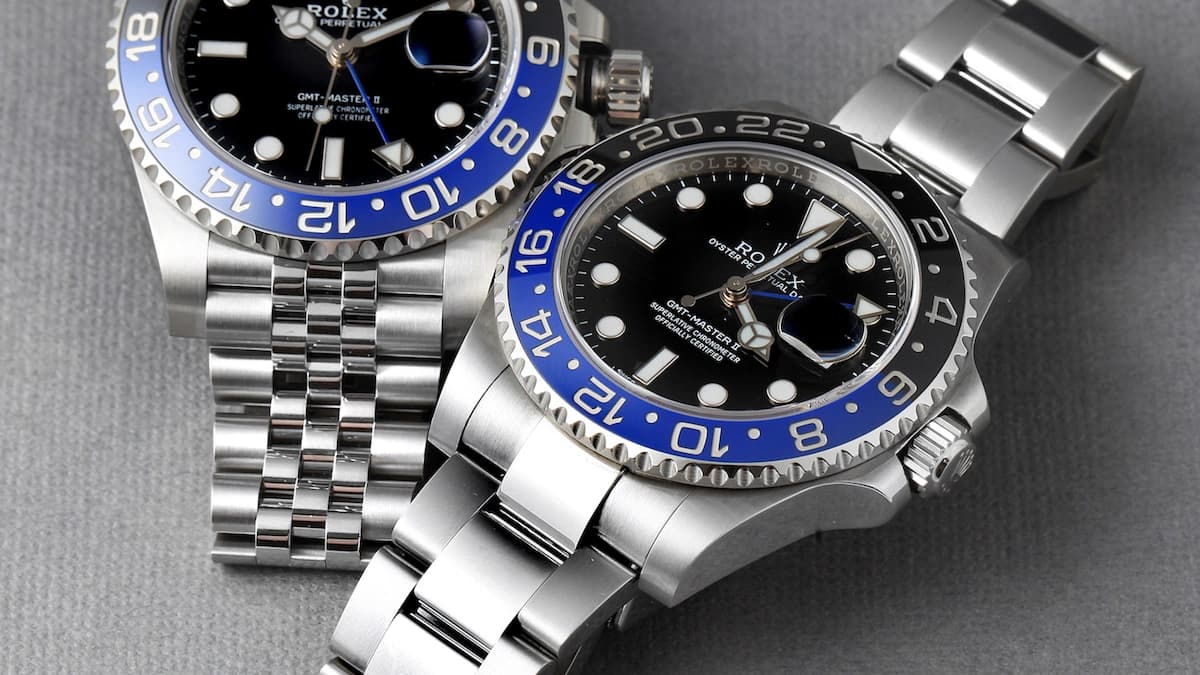
The Oyster bracelet has three rows of links; the Jubilee has five. Visually, the Oyster creates broader surfaces, while the Jubilee divides the surface into smaller elements. Both appear in GMT-Master II history, although the combination of bracelet and watch head should be checked against the particular version. Rolex's GMT-Master II overview discusses both bracelets.
Adjust the bracelet to fit before comparing comfort. A loose fit can let the watch head rotate or move the clasp off-centre, distorting your impression of weight and balance. Look at how the first links follow the wrist, the edges against your skin and the clasp's position underneath.
Switching from Jubilee to Oyster gives the same blue-and-black colour scheme a different visual rhythm on the wrist. Photographs cannot establish play in the links, pin condition or service history. Those details need examination on the actual pre-owned piece. For a replica, bracelet and clasp feel also deserve an assessment separate from the dial.
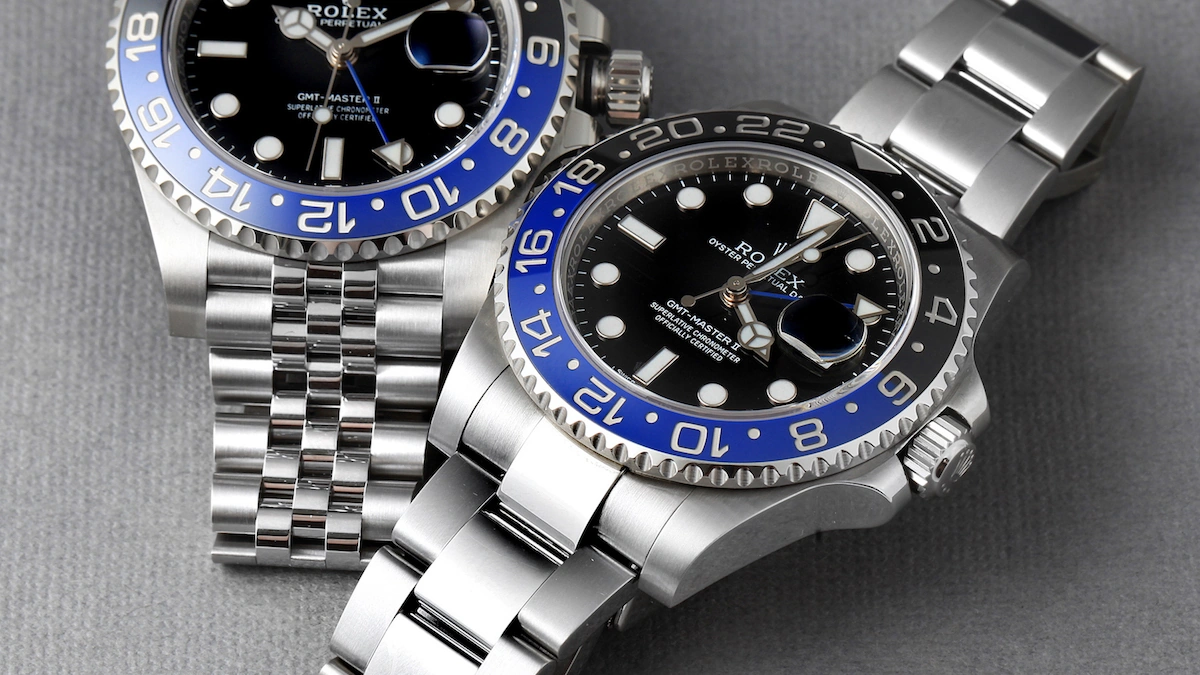
With the same blue-and-black colour scheme, Jubilee and Oyster bracelets create different impressions. Image source: D.Time Luxury.
5. Do the movement and condition match your expectations?
Rolex introduced calibre 3285 in 2018. For the authentic movement, the published power reserve is approximately 70 hours. That does not mean every timepiece described as a GMT-Master II has the same running time. The introduction is documented in the 2018 brochure; the specification and reserve appear in Rolex's brochure for the GMT-Master II 126715CHNR.
For an authentic pre-owned example, consider the exact reference, condition, available service history and working functions. An older example in good condition may suit you better than a newer one with an unclear history. Being newer and being more suitable are separate questions.
For a replica, confirm the actual movement, setting procedure and GMT operation. A 24-hour hand does not automatically mean the local hour hand jumps independently as it does on the Rolex. Equally, the description “clone 3285” needs configuration and inspection information of its own.
Ask for a demonstration of time setting, date changes using the correct procedure, and GMT-hand operation. Water resistance requires appropriate evidence for the individual piece. Clarify who handles warranty work or repairs, too: a satisfying GMT experience includes using and maintaining the actual mechanism correctly.
Choose the GMT-Master II you will enjoy wearing
If you travel frequently, time-setting convenience deserves a high priority. If the design attracts you as an everyday timepiece, bezel colour, proportions and bracelet fit may be what you notice most. Either way, a clearly identified version and information about the actual piece are more useful than a famous nickname alone.
When exploring D.Time's 1:1 Replica Timepieces, you can begin with the colour and bracelet you enjoy. We then consider those preferences alongside appearance, materials, wrist feel and the operation of a suitable version. The aim is a GMT you understand and want to wear regularly.