Researching a BVF Cartier Santos starts with more than a factory name. Learn to assess proportions, case and bracelet finishing, strap-changing functions and the movement actually fitted.
The appeal of a Cartier Santos lies in the whole design: the square form, softened transitions and the way the bracelet meets the case. When considering a replica, the dial often draws attention first. Yet comfort and daily use depend on details a front-facing photograph barely shows.
BV Factory, commonly abbreviated to BVF, is a factory name used in the replica market. D.Time Luxury’s BVF introduction focuses on Cartier Santos and several other designs. It is seller-provided information, not confirmation or certification from Cartier.
Where should an assessment of a BVF Santos begin? We suggest following the ownership experience: proportions on the wrist, surfaces and joints, bracelet adjustment, then movement and support. This guide concentrates on Santos rather than extending conclusions to every design carrying the BVF name.
Identify the Santos and the measurement being quoted
Before comparing versions, establish the same reference design, size, dial colour and bracelet type. Descriptions such as “large Santos” or “40 mm Santos” are not precise enough for a specification comparison. With a non-round case, determine whether a figure describes width, length or a measurement including the crown.
For example, Cartier lists a case width of 39.8 mm for Santos de Cartier reference WSSA0018. That specification belongs to the authentic timepiece. Request measurements for the replica version being offered instead of assuming an exact match.
Then examine wrist and side views. Case height on the wrist, the way the first bracelet links turn downward and clasp placement help explain fit beyond one width figure. If you can try it on, adjust the bracelet first: excessive slack or tightness can distort your impression of the size.
Assess the case and bracelet as a wearable whole
Metal surfaces account for much of what you see on this design. Look at polished-to-brushed transitions, continuity at the case-to-bracelet join, link consistency and the edges touching skin. A bright reflection under a display light is not a complete assessment of manufacture.
View the same piece in soft light and at an angle. Ask for video showing the bracelet articulating gently through normal use. You want to see smooth movement between links, no catching sections or uncomfortable edges, and a clasp that closes securely in ordinary operation.
Do not equate weight with finishing quality. Size and the number of fitted links affect weight. Likewise, articulation that allows a bracelet to wrap around a wrist differs from abnormal play at a joint. Assess those separately rather than assuming that a stiffer bracelet is always better.
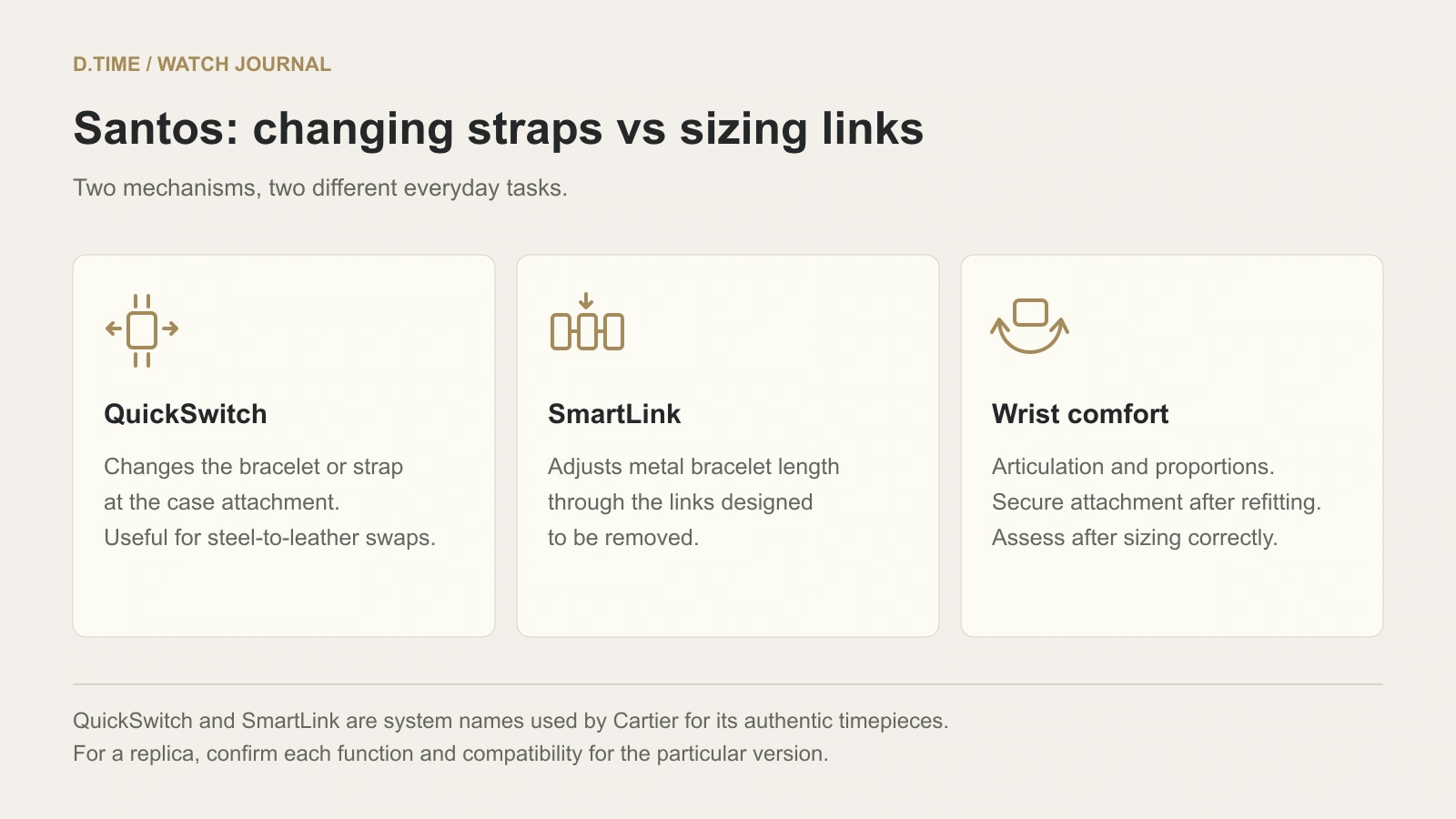
Separating the two tasks helps you request the relevant demonstration for the piece being considered.
QuickSwitch and SmartLink have different jobs
In its description of the authentic Santos WSSA0018, Cartier distinguishes QuickSwitch bracelet interchangeability from SmartLink bracelet adjustment. Understanding the two tasks lets you request the right demonstration for a replica.
If a BVF version is offered with similar mechanisms, separately check detaching and refitting the bracelet at the case, and adjusting the removable links. Convenient interchangeability still requires a secure connection when reattached. Link adjustment should work correctly on the links intended to be removed. One successful function does not confirm the other.
Do not assume authentic accessories fit a replica, or that straps interchange across every replica version. Confirm the size and connection before ordering an additional strap. If a button or pin sticks, ask the supplier to inspect it rather than forcing the mechanism.
“Miyota movement” still needs a calibre number
The reference article mentions Miyota 9015. Treat that as a reason to ask about the piece being offered, not a universal specification for every BVF Santos. Confirm the fitted calibre, its functions and any modifications made for the replica design.
Miyota’s documentation explains why identification matters: the 9015 includes a date function, while the 9039 is listed as a three-hand movement without a date. This comparison distinguishes two movements; it does not establish that a particular BVF contains either one.
Checked on 28 September 2026, Miyota lists 9019 among its discontinued products. This does not identify the movement in a BVF piece or imply that every 9019 still offered has a problem. If an offer says 9019, A9015 or SH9015, clarify the manufacturer and configuration rather than treating those labels as interchangeable spellings of Miyota 9015.
A replica described as Miyota-powered also does not acquire a Cartier movement because its dial reproduces a Cartier design. Ask about setting the time and date where applicable, observed operation and servicing arrangements. A familiar calibre designation cannot establish the condition of the movement inside a completed timepiece.
Inspect the dial without making one letter the whole verdict
A useful dial photograph is near-straight, sharp and free of reflections that obscure the details. Examine alignment, printing, hands and markers. Where a date is present, check its position and legibility. An oblique photograph can distort apparent spacing and shapes.
You may encounter named printing flaws in replica discussions. If a detail matters to you, request an image of the actual piece. A claim that a newer version fixed it is not evidence without an identified version or a visible example of that detail.
Good printing does not establish case material, water resistance or movement longevity. Equally, describe a problem precisely rather than using one small photograph to judge an entire factory. Specific observations make both the discussion and any remedial work more useful.
The whole timepiece should feel coherent
For an everyday design such as Santos, refinement becomes tangible when the details work together: a legible dial, balanced case proportions, an articulated bracelet and a clasp that operates cleanly. A carefully selected version can be convincing in those ordinary interactions, without every assessment depending on a magnified photograph.
If you enjoy switching between steel and leather, convenient and secure strap interchangeability has clear practical value. If you mostly wear the bracelet, its fit and articulation may matter more. Choose around how you intend to wear the piece, alongside the finishing of the particular version.
Keep a practical record before deciding
We suggest retaining a short information set:
- The reference design, size and replica configuration.
- Front, side, rear, bracelet and clasp images of the actual piece.
- Video of the advertised strap-changing, link-adjustment and movement functions.
- The confirmed calibre, inspection information and unresolved questions.
- Service terms, warranty scope and sending or return arrangements for support.
Use the same information set when comparing two offers. Price becomes meaningful when the version and included service are clear; a general “BVF price” cannot replace that description.
At D.Time, factory names form part of the technical discussion. We select versions and inspect individual timepieces before delivery, providing photographs or video of the customer’s actual piece. With Santos, wrist proportions, bracelet comfort and everyday controls deserve attention alongside the dial.
A BVF Santos worth considering should make its case through details you can see, understand and use. Clear information lets you choose an ownership experience that suits you, rather than simply the most frequently repeated name.
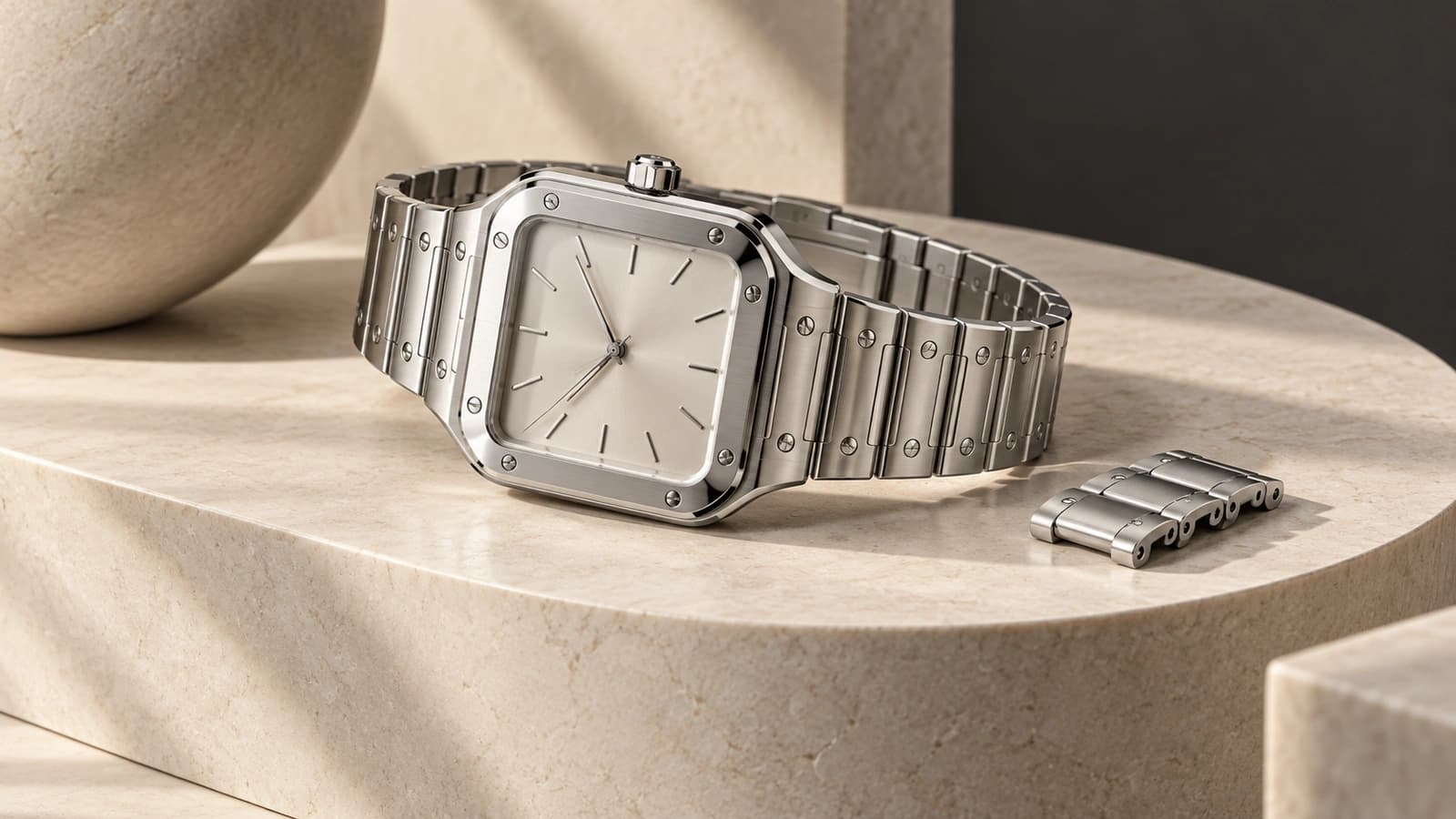
AI-generated editorial illustration of proportions and bracelet fit, not an actual Cartier or BVF photograph.