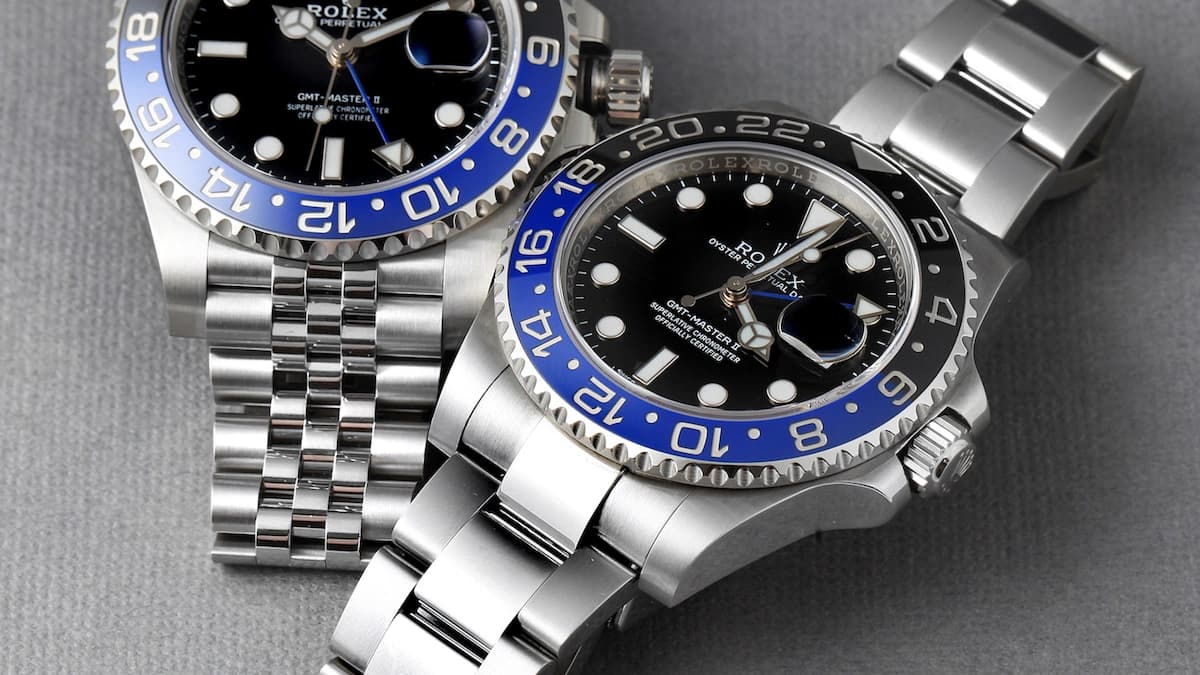

GMT and dual time can both keep track of two places, but their displays and setting mechanisms differ. For travel, focus on independent hour adjustment, day and night, and which time zone controls the date.
After arriving, you want your watch to show local time while keeping home time available. A GMT can do that, and so can a timepiece described as dual time. The distinction is less rigid than the two names suggest.
In common watch terminology, GMT usually refers to an additional hand that completes one rotation every 24 hours. Dual time is a broader description of two time-zone displays. The categories overlap. For travel, the useful differences are how you set the time and how you read it.
Two names with overlapping uses
GMT stands for Greenwich Mean Time, but a GMT hand does not necessarily have to remain set to Greenwich time. Depending on the movement and setup, it can serve as your home-time reference.
Rolex describes the GMT-Master II as showing local time with the conventional hour hand and reference time with a 24-hour hand. Both displays share the minute hand.
Dual time may instead use a subdial or a separate face. The Jaeger-LeCoultre Reverso Tribute Duoface Small Seconds Q3908410 presents two time zones on opposite faces, with a day/night indicator on the reverse. Turning the case is a different interaction from reading an extra hand on one dial.
Which hand can you adjust independently?
This matters when you land. An independently adjustable local hour hand lets you change the main display without disturbing the minutes or your reference time.
The GMT-Master II user guide specifies one-hour steps for the local hour hand, with the date linked to local time. Consult the instructions for the exact model before operating its crown.
Another arrangement allows independent adjustment of the 24-hour hand. This can suit someone who stays in one place but frequently changes the distant time zone they track. An independently adjustable extra hand does not establish that the main hour hand can also be adjusted separately. Ask for a demonstration of the actual function.
The Duoface offers a different interface. In its explanation of calibre 854 Duoface models, Jaeger-LeCoultre describes crown adjustment for the minutes on both faces and the hours on the front, with a slider adjusting the reverse-side hour display. A shared purpose can involve a very different routine.
Learn the 24-hour scale first
A conventional hour hand completes two rotations daily; a 24-hour hand completes one. Read the latter against its own scale. The 18-hour region indicates evening; read the minutes from the minute hand. The 24-hour hand advances between the hour markers rather than remaining on a numeral for a whole hour.
For a hypothetical example, home time is 10:10 and your destination is two hours ahead, at 12:10 on the same day. With the appropriate setup, the main display reads 12:10 while the 24-hour hand retains home time. This illustrates a two-hour difference rather than the current offset between particular cities.
On the GMT-Master II, the bezel's triangle sits at 12 o'clock in the neutral position. Rotating the bezel changes the scale against which you read the 24-hour hand. It does not move the hand or automatically recognise your location. Start with the bezel in its neutral position until reading both times becomes familiar.
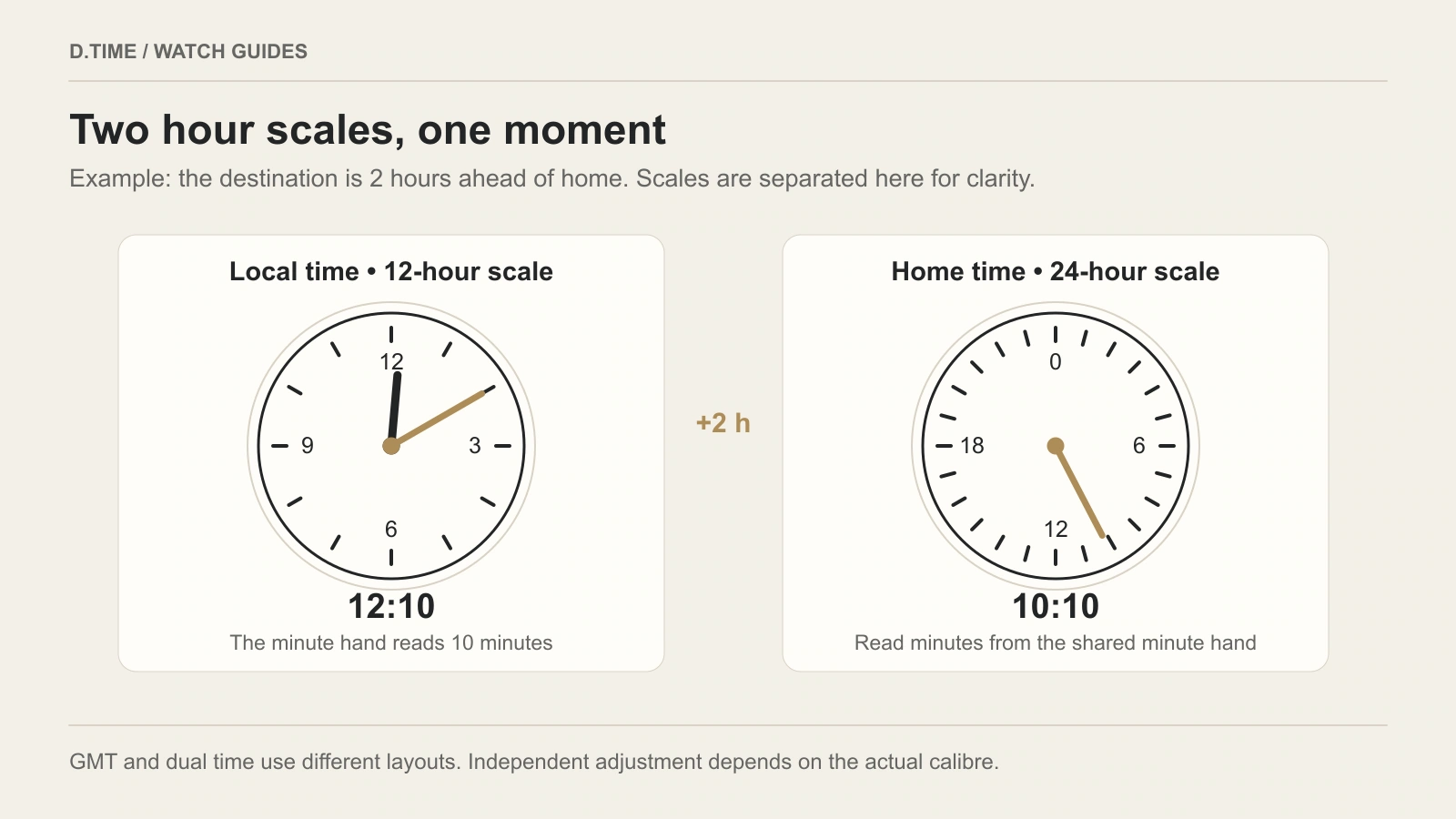
The scales are separated for clarity: at the same moment, the destination is two hours ahead of home. A single-dial GMT may place these hands on the same centre.
Consider day, date and fractional offsets separately
One location may already be on the following date. A 24-hour display or day/night indicator helps distinguish morning from evening, but it does not necessarily provide a separate calendar for each location. Establish which time zone controls the date window.
The mechanical examples here do not automatically apply local daylight-saving rules. Check the offset for the date of your journey. A difference remembered from an earlier trip may change with the season.
A one-hour jumping mechanism also does not automatically accommodate every 30- or 45-minute difference. Check the exact movement if your route involves fractional offsets. Two sets of hands do not necessarily mean two independently adjustable minute displays.
Match the interface to your travel habits
Frequent travellers who maintain one home-time reference may value quick local-hour adjustment most. Someone coordinating with overseas colleagues from one location may prioritise changing the reference time. A person who prefers fewer hands on one dial may enjoy turning a Duoface over.
We suggest a practical check:
- Set two hypothetical times and change local time while preserving the home reference.
- Read the reference in both morning and evening settings.
- Confirm which display controls the date and how midnight is handled.
- Check fractional-offset needs, legibility and the actual setting controls.
For a replica, demonstrate these functions on the version being considered. A fourth hand alone does not establish independent adjustment or the authentic model's full mechanism.
A useful travel timepiece answers two questions clearly: what time is it here, and what time is it where I need to make contact? When reading and setting it become natural, the complication earns its place in your journey.
AI-created D.Time concept image about time in two places; it does not represent an actual watch reference.