An automatic timepiece can gain or lose time, but a single reading does not establish a fault. Learn how to record its rate, use the correct specification and recognise when a technical inspection is appropriate.
Your timepiece is 20 seconds ahead of your phone this morning. Should you reset it or arrange an inspection? The answer depends on how long those 20 seconds took to accumulate, which movement is fitted and whether its behaviour has changed.
Arrange an inspection if the daily rate repeatedly exceeds the applicable specification, changes substantially from its previous pattern or the timepiece stops despite correct winding. Moisture under the crystal, a jammed function or abnormal behaviour after an impact calls for prompt attention. When operation is otherwise consistent, start by logging the rate and checking the correct specification.
Understand the reading first
Rate is usually expressed in seconds per day: positive means gaining time and negative means losing it. Rolex explains in its FAQ that lifestyle and real-world use influence performance. When assessing a reading, record wearing time, winding and resting position as well as the time offset.
Being 20 seconds ahead is therefore not the same as gaining 20 seconds per day. An offset accumulated over four days tells a different story from the same offset appearing since yesterday.
We also distinguish the size of the error from its consistency. One tells you how fast or slow the timepiece runs; the other shows how much the result varies between comparable days. Both help a technician understand the issue.
How much time should an automatic watch gain or lose?
Automatic describes a self-winding mechanism. Movements and testing programmes have different performance requirements.
For example, the Rolex Explorer 40, reference 224270, uses calibre 3230 and has a published precision of −2/+2 seconds per day after casing. The Cartier Santos de Cartier Large, reference WSSA0018, uses calibre 1847 MC. Both are automatic, but that does not make the Explorer specification applicable to the Santos. Use the documentation and conditions for the particular model and movement.
For an older example, condition and service history also matter. For a replica, establish the actual movement and the accompanying performance information. A model name, dial inscription or decorative calibre marking does not transfer the authentic reference's standard to the replica.
If no confirmed tolerance is available for that version, ask the supplier to clarify it. An often-repeated online figure is not a substitute for an applicable specification.
How to measure an automatic watch's daily accuracy
We suggest recording performance for 5–7 days if the timepiece is operating normally and has no symptom requiring prompt attention.
- Choose a synchronised reference that displays seconds, and use it throughout.
- Set the time according to the correct movement instructions, or record the initial offset if you cannot synchronise the seconds precisely.
- Note the offset at the same time each day, together with wearing time, winding and overnight position.
- Avoid resetting it during the observation period. If you do reset it, or it stops, begin a new record.
For a hypothetical example, start at zero and record +6 seconds after 24 hours, +13 after 48 and +19 after 72. The separate daily gains are +6, +7 and +6 seconds, averaging approximately +6.3 seconds per day. Do not average the three cumulative offsets.
If the initial offset was +5 seconds and the final offset after three days was +23, the accumulated gain was 18 seconds: an average of +6 seconds per day. Subtracting the starting offset prevents a setting discrepancy from distorting the result.
Formula: average daily rate = (final offset − initial offset) ÷ elapsed time in days. For observations 36 hours apart, use 1.5 days rather than treating the interval as a full day.
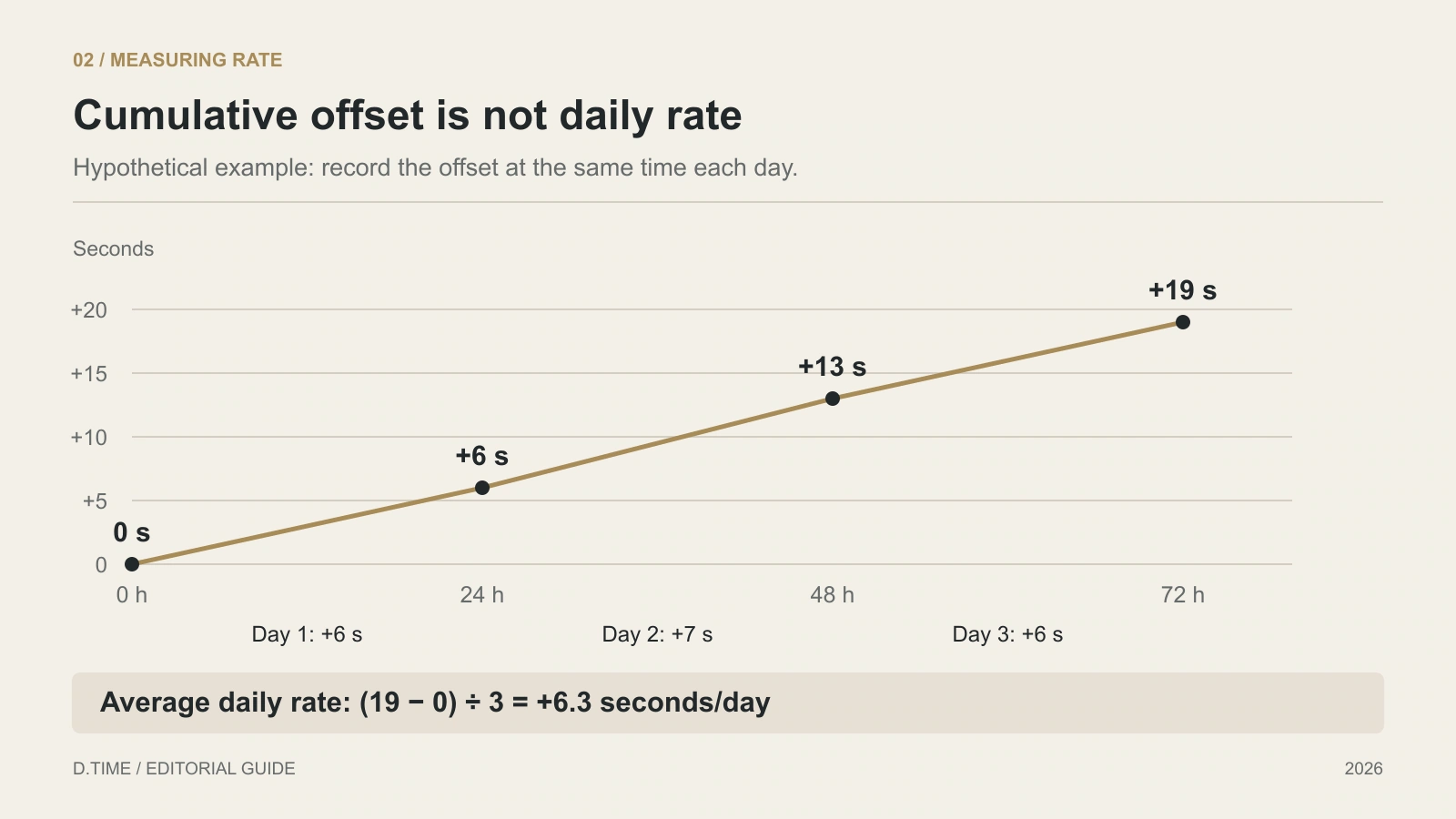
Hypothetical offsets of 0, +6, +13 and +19 seconds give an average daily rate of approximately +6.3 seconds over three days. Diagram: D.Time.
Check the context before assuming a fault
Energy and wearing habits
Wearing a timepiece does not guarantee sufficient winding. Review your routine and the instructions for the actual movement. For example, Rolex recommends manual winding before first use or after the watch has stopped. This illustrates restoring energy before assessing performance; it is not a universal procedure for every automatic movement.
Avoid applying one universal crown-turn count. Hand-wind only when supported by the movement, follow its instructions and do not force an unexpectedly stiff or jammed crown.
Environment and recent changes
Note whether the change followed an impact, a different routine or close exposure to a magnetic object. Cartier explains that magnetic fields can interfere with the oscillator of a mechanical timepiece and cause timing errors. Magnetic resistance depends on the particular design, configuration and specification; the brand name alone does not establish it.
A fast rate alone does not establish magnetisation. Your record supports diagnosis; it does not replace testing. Deliberately bringing the timepiece close to another magnet will not provide a useful confirmation.
Decide how soon to arrange an inspection
Continue observing when performance is consistent, there are no other symptoms and you lack a complete record or the correct specification. Establish those first.
Arrange an inspection when the rate repeatedly exceeds the applicable specification, changes substantially from its previous behaviour under a comparable routine, or the timepiece repeatedly stops despite correct winding. The cause should be established before simply adjusting the rate.
Contact a technician promptly after a significant impact followed by abnormal behaviour, if moisture appears beneath the crystal, or if the crown or a function jams. There is no reason to wait a week to complete a log in those circumstances.
These are priorities for action, not a remote diagnosis. Avoid opening the caseback or moving regulating components simply to chase a reading close to zero.
What a timing-machine photograph can establish
Professional instruments report more than rate. Witschi lists rate variation, amplitude, beat error and lift angle among the measurements of its WisioScope, which combines acoustic and optical measurement. This does not mean that every timing machine independently measures lift angle. Amplitude describes the balance wheel's angular swing; beat error describes a timing asymmetry between its alternating beats.
Ask which position was measured, how well the mainspring was wound, how long the measurement lasted and what else was checked. A near-zero daily rate is a result under those test conditions. It does not establish a week's accuracy on the wrist, water resistance or years of durability.
For a timepiece purchased from D.Time, you can share your rate log and when the change began so we can help with an inspection. Specific observations make that conversation more useful than a general impression of poor timekeeping.
The meaningful assessment brings together the applicable specification, your routine and the observed pattern. With all three, you can decide when further observation is reasonable and when a technician should take a closer look.
AI-generated editorial illustration for D.Time; not a photograph of an actual product.