Diameter tells only part of the sizing story. Lug-to-lug length, thickness, bracelet construction and dial proportions all shape how a timepiece feels on your wrist and works with your style.
You may feel perfectly comfortable wearing one 40 mm timepiece, then find another with the same diameter larger, bulkier or harder to keep centred. That does not mean your original sizing choice was wrong. The 40 mm figure simply leaves part of the story untold.
Two 40 mm watches can fit differently because of their lug-to-lug length, lug curvature, thickness and the point where the bracelet starts to fold down. Dial and bezel proportions also affect how large they look. Case diameter is therefore a starting point for choosing a size, rather than a complete measure of wrist fit.
Diameter is the starting point
On a round timepiece, diameter generally describes the width of the case without the crown and pushers. It does not tell you how far the lugs extend, how much the caseback protrudes or where the bracelet articulates. Square, rectangular and integrated designs need particular attention to the manufacturer's measurement conventions.
For a concrete example, Omega lists the Seamaster Railmaster 40 mm, reference 220.10.40.20.03.001, at 40 mm in diameter, 12.7 mm thick and 47 mm from lug to lug. Those three figures describe three different dimensions. Keeping only the diameter discards two useful clues about fit.
Use diameter to create a shortlist, then ask how each complete timepiece sits on your wrist.
What is lug-to-lug, and how does it affect watch fit?
Lug-to-lug is the distance between the tips of the lugs at 12 and 6 o'clock. The lugs connect the case to the strap. This measurement is different from lug width, which describes the gap into which a strap fits.
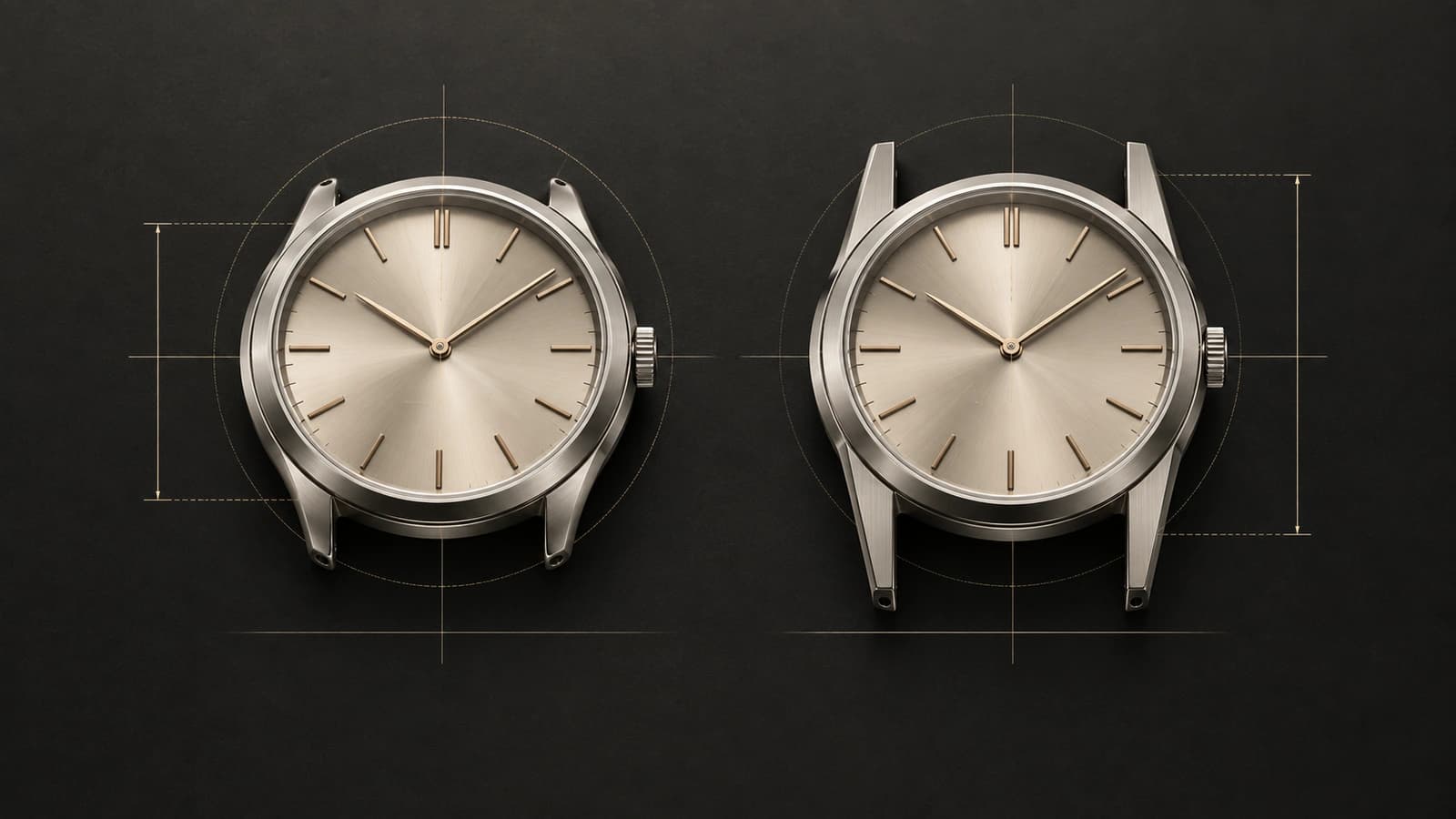
Imagine two 40 mm cases with lug-to-lug measurements of 46 mm and 51 mm. These are hypothetical dimensions, not specifications of two products on sale. The second extends 5 mm farther along the wrist despite having the same case width.
Longer lugs do not automatically mean less comfort. Curved lugs may follow the wrist more closely than straight ones. Two wrists with the same circumference can also have different profiles across the top. No chart matching circumference to diameter can fully replace trying a timepiece on.
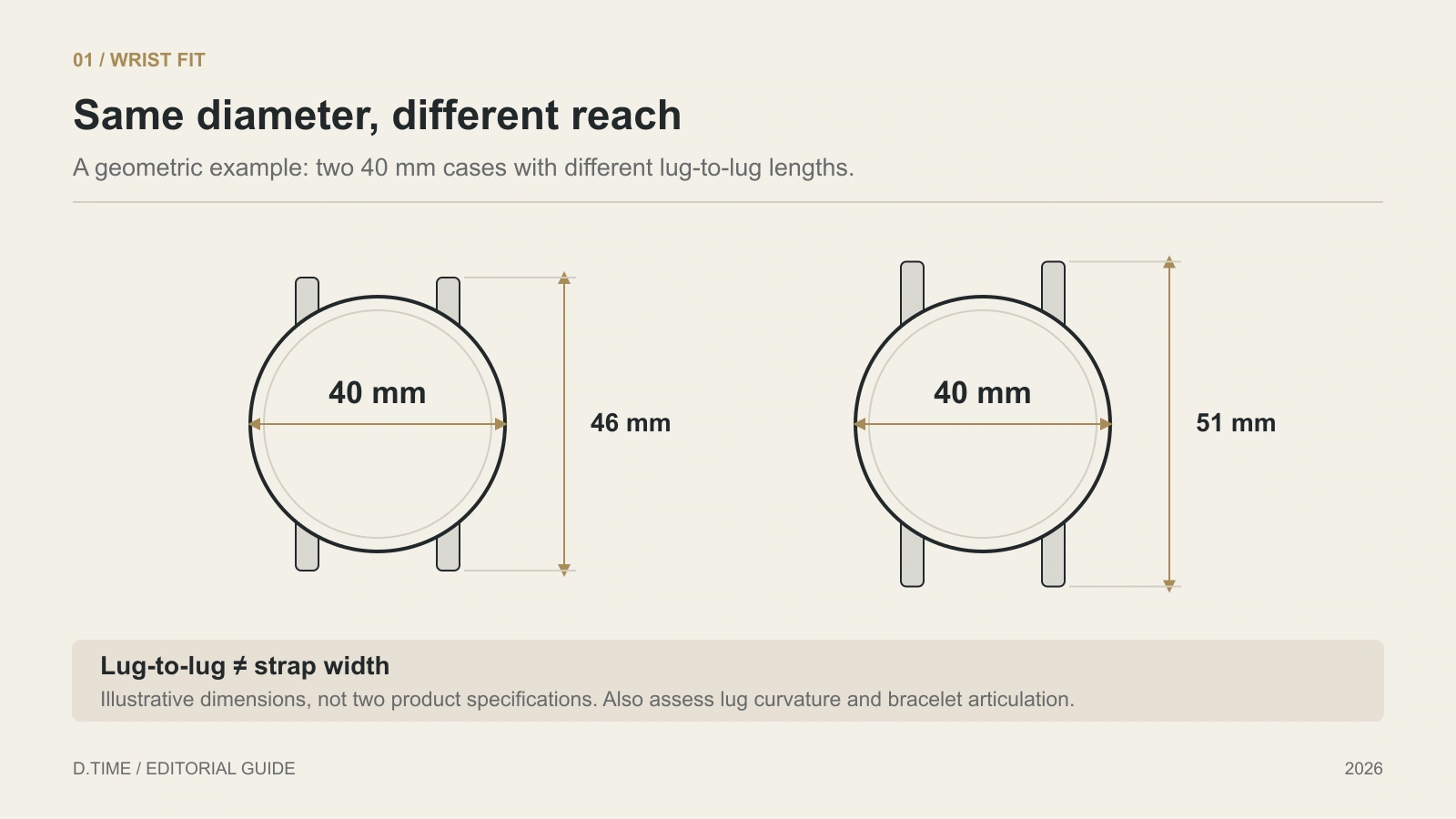
Two 40 mm cases can have lug-to-lug lengths of 46 mm and 51 mm. These are illustrative dimensions, not specifications of two products. Diagram: D.Time.
The bracelet can extend the fit beyond the case
Look at the junction between bracelet and case from the side. If an end link projects outward and cannot immediately fold down, the timepiece needs additional space before the bracelet starts wrapping around your wrist. Its effective reach can extend beyond the lugs.
On an integrated design, locate the first joint that actually moves. A bracelet that articulates close to the case can fit more compactly than one with a rigid first section, even when the case dimensions are similar.
Bracelet adjustment matters, too. A loose bracelet allows the case to slide sideways and feel cumbersome; an overtight bracelet can make a small case uncomfortable. Size it reasonably close to your intended fit before judging the result.
Thickness and caseback shape affect how it sits
A taller case may catch a shirt cuff or tilt if its weight sits high and the bracelet is loose. Overall thickness still leaves out the shape of the crystal, mid-case and caseback, all of which influence how the complete object meets the wrist.
Cartier describes the Ballon Bleu 40 mm, reference WSBB0061, as approximately 12.4 mm thick, while the Railmaster 40 mm above measures 12.7 mm. Their diameters match, but their height and case shapes differ. That dimensional difference is only one part of fit; it does not establish which feels more comfortable.
From the side, check whether the caseback creates a concentrated pressure point, whether the sides sit high and whether the crown presses against your hand when you bend your wrist. These observations tell you more than assuming thinner is always better.
Dial and bezel proportions change visual size
Equal case diameters can frame different amounts of visible dial. A broad bezel surrounding a smaller dial creates a different composition from a narrow bezel and an open dial. Empty space, markers and contrast further influence that impression.
This is a way of reading design proportions, not a fit formula. A timepiece that looks large can still feel comfortable, while a compact-looking dial says little about the reach of its lugs and bracelet.
Consider whether you want the design to blend into your outfit or become a focal point. The right presence for your style is not necessarily the smallest possible presence.
Will a 40 mm watch fit your wrist?
No single wrist circumference guarantees that every 40 mm watch will fit. Check whether the lugs and end links sit within the top of your wrist, then look for pressure points as you move. We suggest this practical sequence:
- Adjust the bracelet, then look straight down at the lugs and end links.
- Check the caseback, height and first articulating link from the side.
- Gently bend and rotate your wrist, then rest your hand on a desk as you would while working.
- Try it with the cuffs you normally wear.
- Look at the complete outfit in a mirror and take a photograph from farther away; avoid relying on one extreme close-up.
When buying remotely, request side views, overhead views and measurements of the exact model. A timepiece you already wear comfortably makes a useful reference: compare its diameter, lug-to-lug length and thickness with the new design.
For a replica, ask for the dimensions and weight of the actual version. The original brand's specifications describe the authentic reference; they do not establish the replica's dimensions, materials or wrist feel.
The useful outcome is a timepiece that stays stable, avoids pressure during everyday movement and has the proportions you want to express. Diameter starts the selection process. Your wrist and daily routine complete it.
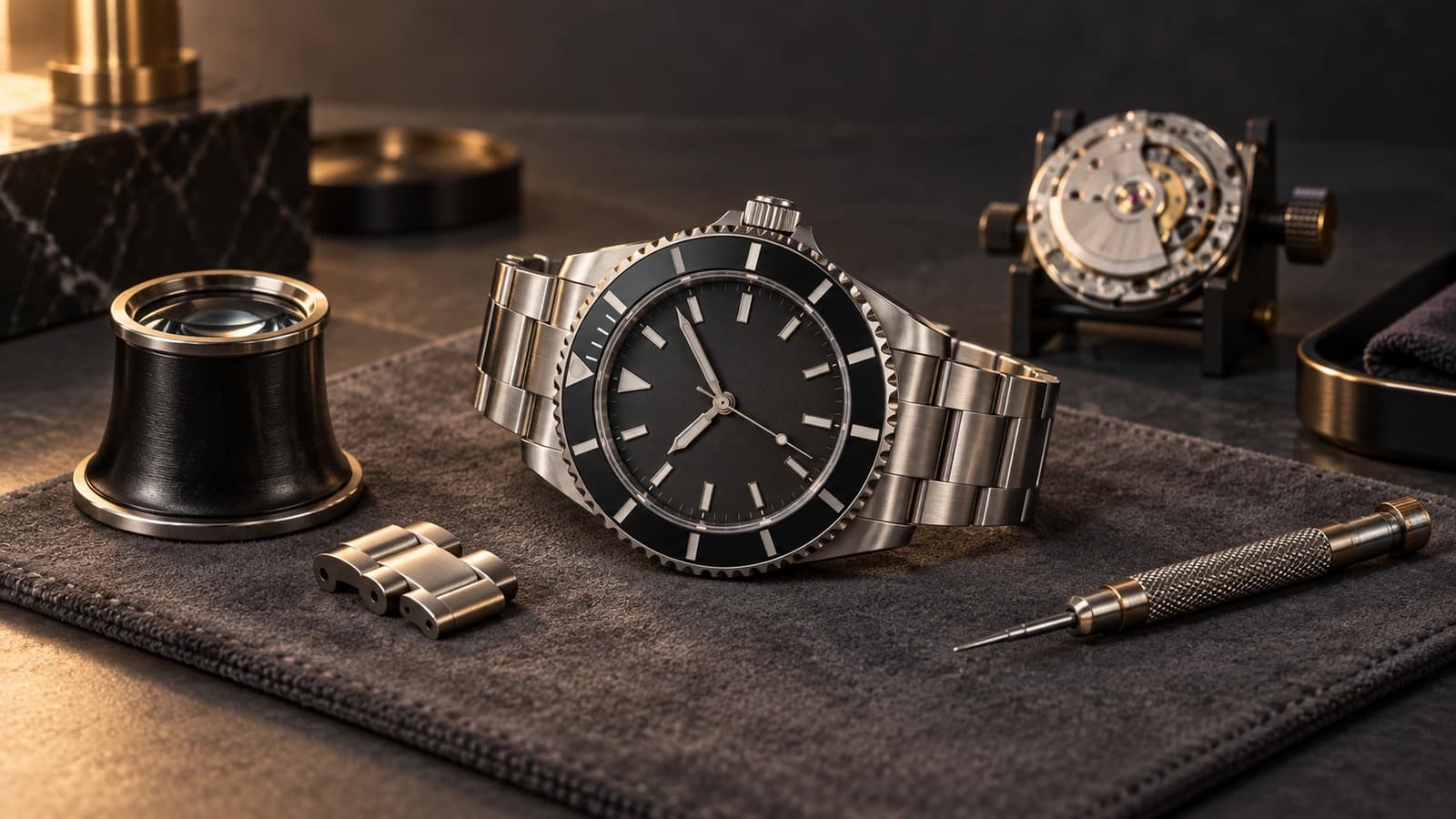
AI-generated editorial illustration for D.Time; not a photograph of an actual product.