904L offers material advantages in certain corrosive environments, but an alloy designation does not describe an entire timepiece. Machining, finishing, construction and evidence for the actual components matter too.
If one timepiece uses 904L steel and another uses 316L, is the first necessarily better? The question often combines several different properties: corrosion resistance, scratching, lustre and manufacturing quality.
904L offers greater corrosion resistance in certain environments, but that does not make every 904L watch more scratch-resistant or better finished than a 316L watch. An alloy designation describes part of the starting material. The finished timepiece also depends on machining, finishing, assembly and inspection.
What is the difference between 904L and 316L steel?
Both belong to the austenitic stainless steel family. You do not need to memorise metallurgy terminology to choose a timepiece. The useful distinction is that these are alloy choices, not quality scores for a complete product.
Outokumpu describes 316L as a low-carbon chromium–nickel–molybdenum steel. Its 904L description highlights higher nickel and molybdenum content and corrosion resistance for demanding applications, including chemical processing.
Material selection therefore creates real differences. How much they benefit a particular timepiece still depends on its environment, design and condition.
Corrosion resistance needs a context
Corrosion concerns chemical or electrochemical interaction with the environment. A scratch from contact with a desk edge is a different issue. A claim of high corrosion resistance does not provide an abrasion or impact test result.
Outokumpu's Ultra range technical data compares alloys under specified chemical and temperature conditions. Those conditions make the results meaningful. They are not a simulation of every possible circumstance over years of wrist wear.
Ask which need the material advantage addresses and what has actually been tested. A benefit in corrosion resistance should not become a promise of superior durability in every respect.
Similarly, the steel grade does not establish water resistance. That depends on the complete construction, seals, assembly condition and testing. A 904L label cannot replace that evidence.
Is 904L steel more scratch-resistant than 316L?
If a seller claims that 904L scratches less than 316L, ask which components, surfaces and test method support the comparison. Naming the alloys does not answer those questions.
Hardness, manufacturing condition, surface treatment and use all deserve consideration. How visible a scratch appears is also different from how readily it forms. A fine mark may stand out on a polished surface under certain lighting while presenting differently against a brushed finish.
This does not dismiss 904L's advantages. It sets a specific expectation: an advantage in one material property should be assessed as that property, without becoming a promise of permanently pristine appearance.
Finishing shapes how the steel looks and feels
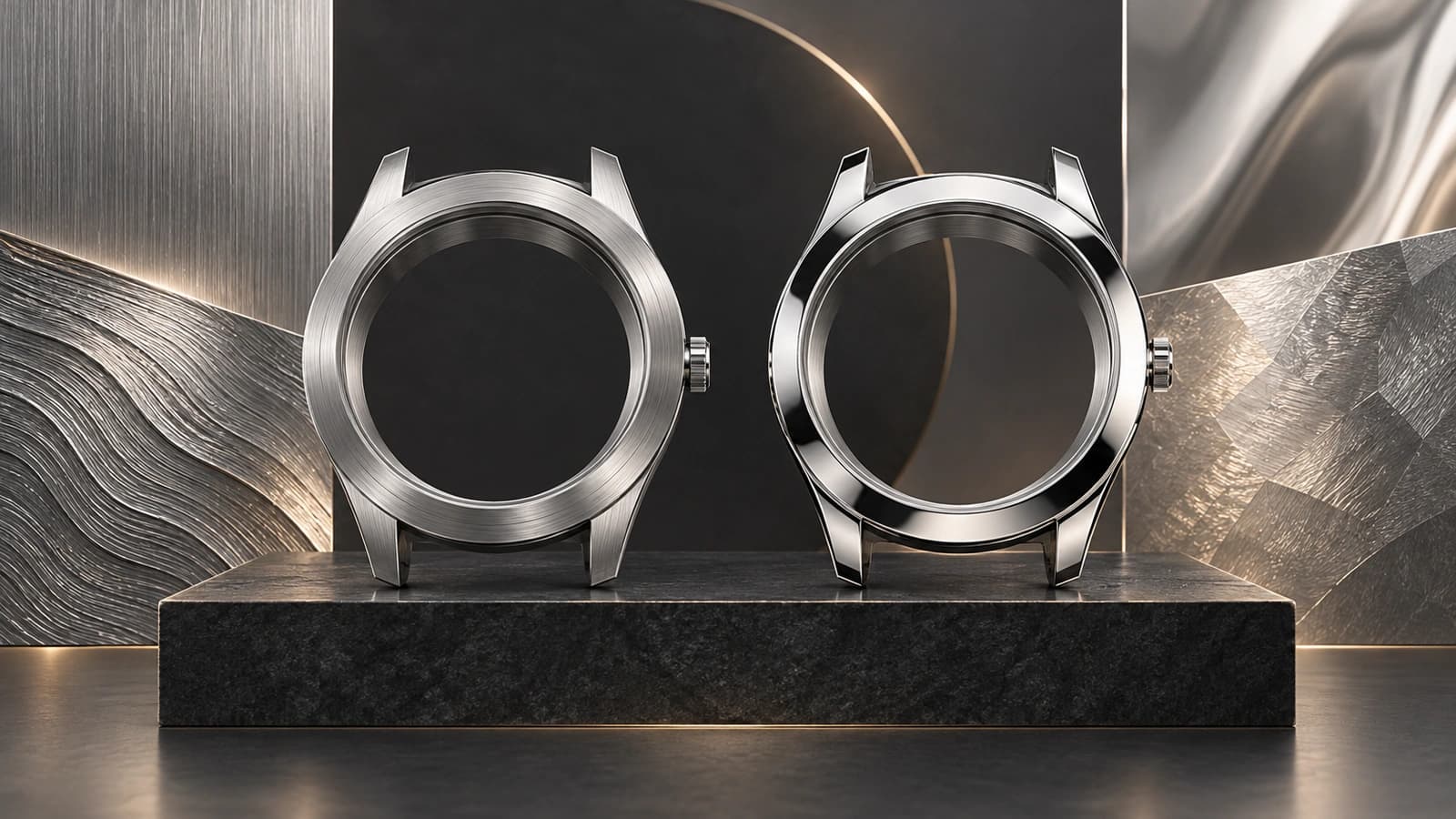
Examine the transition between brushed and polished areas. Is the boundary clean? Is the brushing consistent? Do flat surfaces retain their intended geometry? Do edges press uncomfortably against the skin?
These questions concern execution. A material label cannot answer them. Even with the correct alloy, edge definition, surface consistency and bracelet fit require separate assessment.
We suggest comparing under the same lighting and viewing angles. Heavily colour-edited images or one flattering reflection make finishing harder to judge. Macro photographs reveal details; wider views show whether those details form a coherent whole.
Oystersteel is not a generic name for all 904L steel
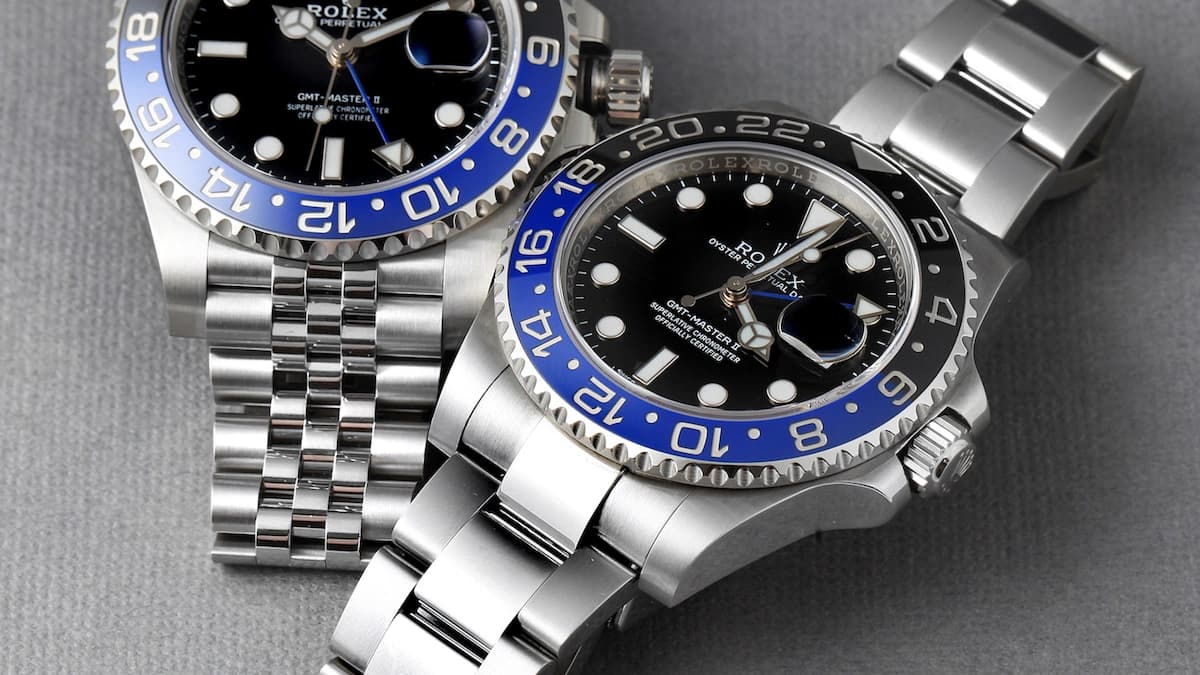
Rolex identifies Oystersteel as grade 904L and describes its own material controls and finishing process. The Explorer 40, reference 224270, provides a concrete example: its case and bracelet are specified as Oystersteel. These sources explain Rolex products; they do not certify steel described as 904L by another supplier.
Sharing an alloy designation is therefore insufficient to establish identical cases, manufacturing processes or finishes. The material category and the work that turns it into a product are separate considerations.
316L is not evidence of poor quality either. In the materials section for the Omega Seamaster Diver 300M, reference 210.30.42.20.03.001, Omega identifies 316L stainless steel. Alongside the Explorer, this shows that luxury brands can choose different steel grades. Each complete timepiece still needs assessment of design, machining, finishing and performance.
Confirm individual components on a replica
A 904L specification for an authentic reference does not establish the alloy used by a replica version. Nor should a case specification automatically be extended to its bracelet, clasp, pins and internal parts.
When a description says 904L, useful questions include:
- Which components does the claim cover?
- Is it supplier information or a test result for the actual timepiece?
- If testing is available, where was the sample taken, which method was used and what does the result establish?
- Do the photographs and videos show the machining, edges and joints of the version being offered?
Colour, shine and perceived weight do not replace material identification. Equally, confirmation of the alloy does not establish movement performance, functionality or fit.
Missing documentation does not itself prove that a material claim is false. If your decision depends on the alloy, however, missing evidence should be clarified rather than replaced by an attractive photograph.
Assess material and execution together
A practical comparison starts with the confirmed material, then considers surfaces, edges, joints and use. Put those findings alongside the price and your needs. If a price difference is attributed to 904L, examine whether the stated benefit is supported by the available evidence.
At D.Time, materials are one of four selection pillars, alongside appearance, wrist feel and movement performance. They are assessed together with workmanship and the complete timepiece.
904L and 316L are both useful information. A well-grounded choice depends on understanding what that information establishes and what still needs separate observation or testing.
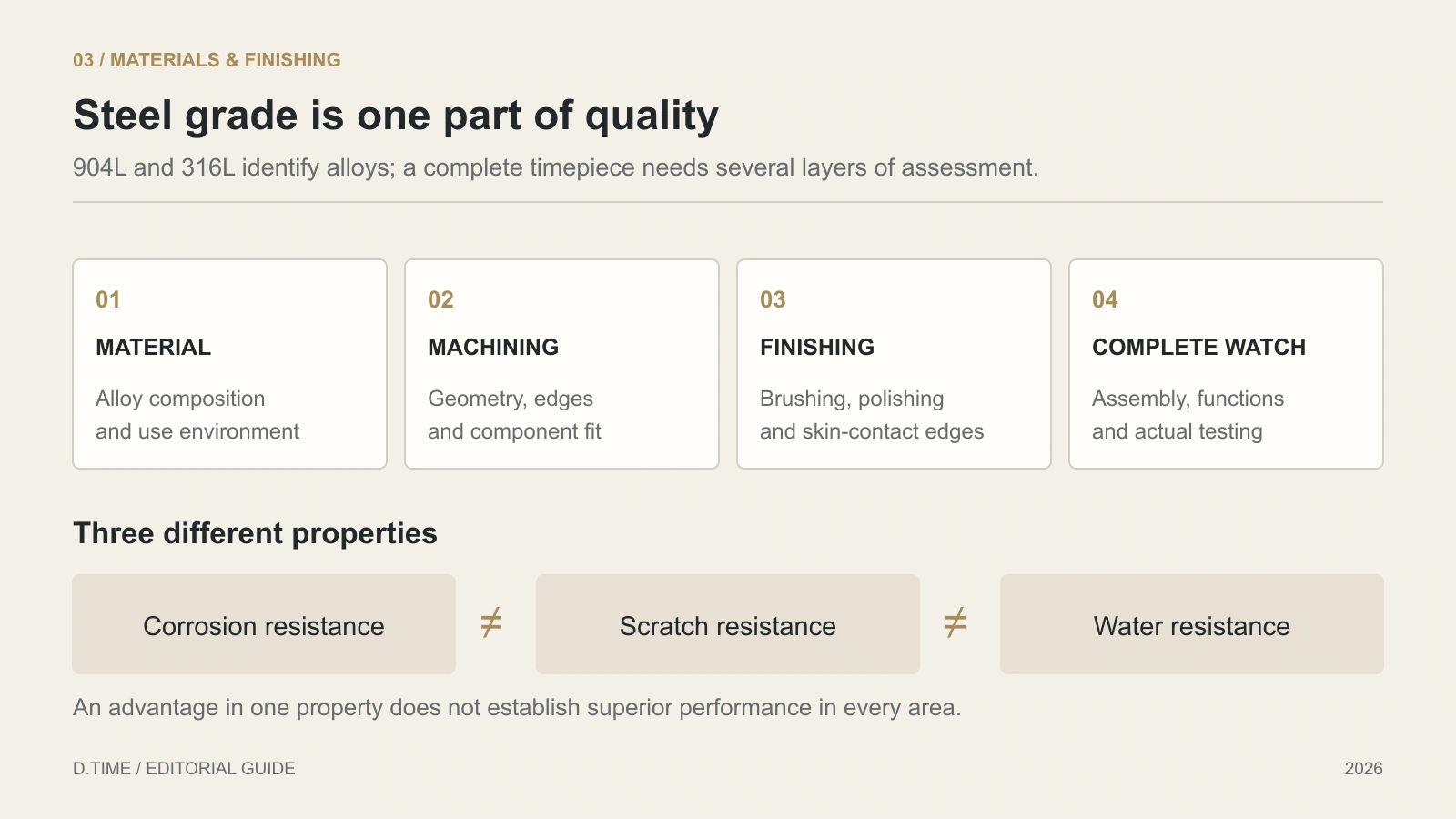
Assess material, machining, finishing and the complete timepiece separately. Corrosion, scratch and water resistance are distinct properties. Diagram: D.Time.
AI-generated editorial illustration for D.Time; not a photograph of an actual product.