Sapphire offers valuable scratch resistance. Understanding Mohs hardness, AR coatings and impact damage helps you choose and care for a timepiece with clearer expectations.
You tilt your wrist towards the light and notice a fine line across the crystal. The watch was described as having sapphire, so why is there a mark? Is the material wrong, or was the expectation too absolute?
Sapphire can be scratched, but its high scratch resistance is still a valuable benefit in daily wear, helping the crystal retain clarity through many ordinary contacts. Strong scratch resistance does not mean immunity to damage, and a visible mark may affect a coating or be a surface deposit. Before drawing conclusions or attempting polishing, establish which surface and type of damage you are looking at.
What is sapphire crystal in a watch?
The familiar term can sound like ordinary glass made harder through treatment. The underlying material is synthetic sapphire, a crystalline form of corundum. IWC describes its watch sapphire as synthetically produced and rated 9 on the Mohs scale.
Laboratory production does not make it imitation sapphire. For a watch crystal, the aim is a transparent component manufactured to the required shape and suited to the case. Material identity is different from the natural origin associated with jewellery gemstones.
The word sapphire is also an incomplete specification. Curvature, thickness, edges, coatings and mounting all matter. Two sapphire-equipped timepieces can produce different reflections and views of the dial.
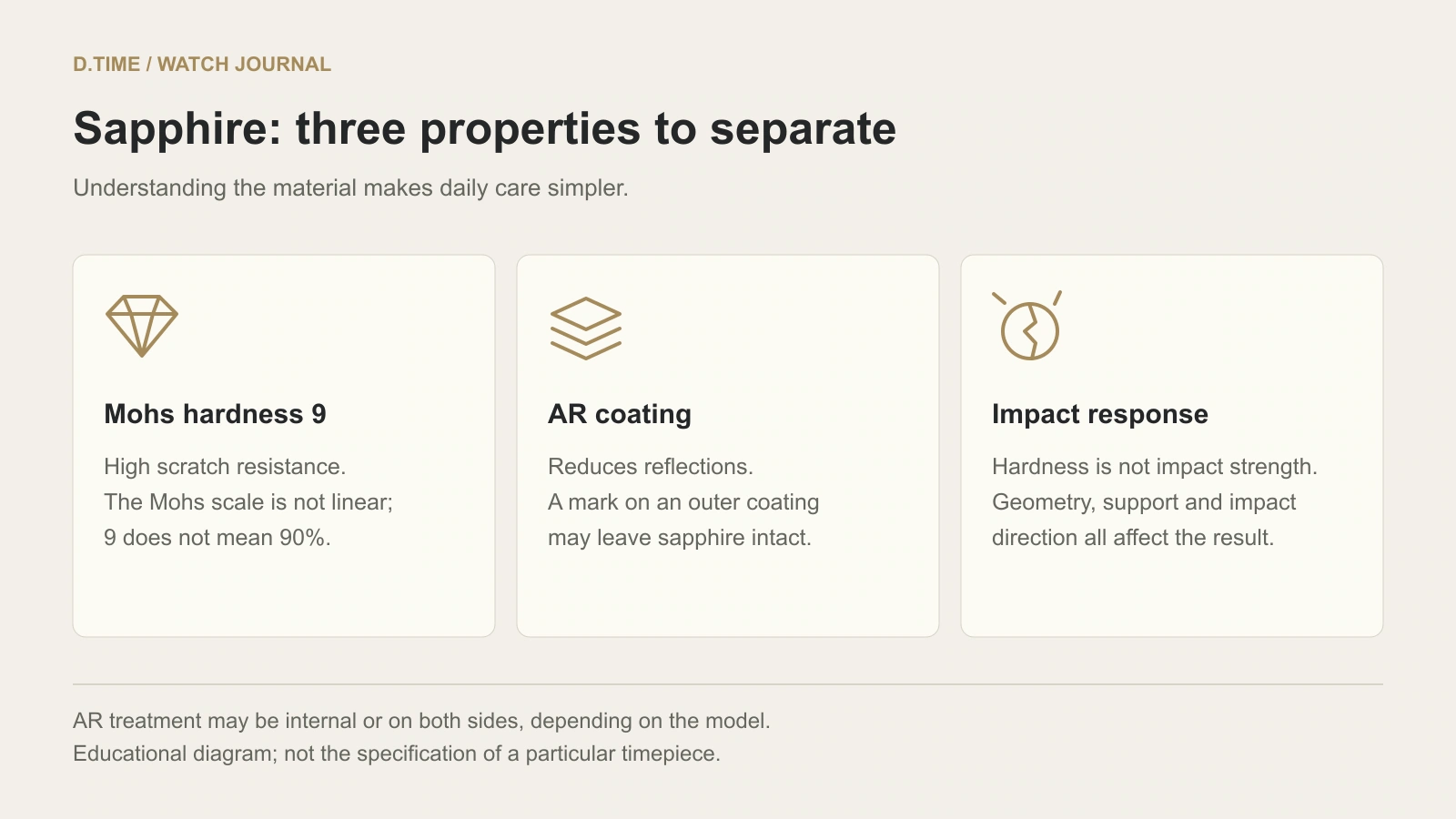
Hardness, coating and impact response answer three different questions about a sapphire crystal.
What does Mohs hardness 9 tell you?
GIA explains the Mohs scale through the ability of one mineral to scratch another. Its steps are not evenly spaced. Sapphire's 9 and diamond's 10 therefore do not mean sapphire is 90 per cent as hard as diamond.
High hardness helps it resist many everyday sources of scratching. A sufficiently hard abrasive can still cause damage. Hardness is neither a promise of a permanently unmarked surface nor an impact test.
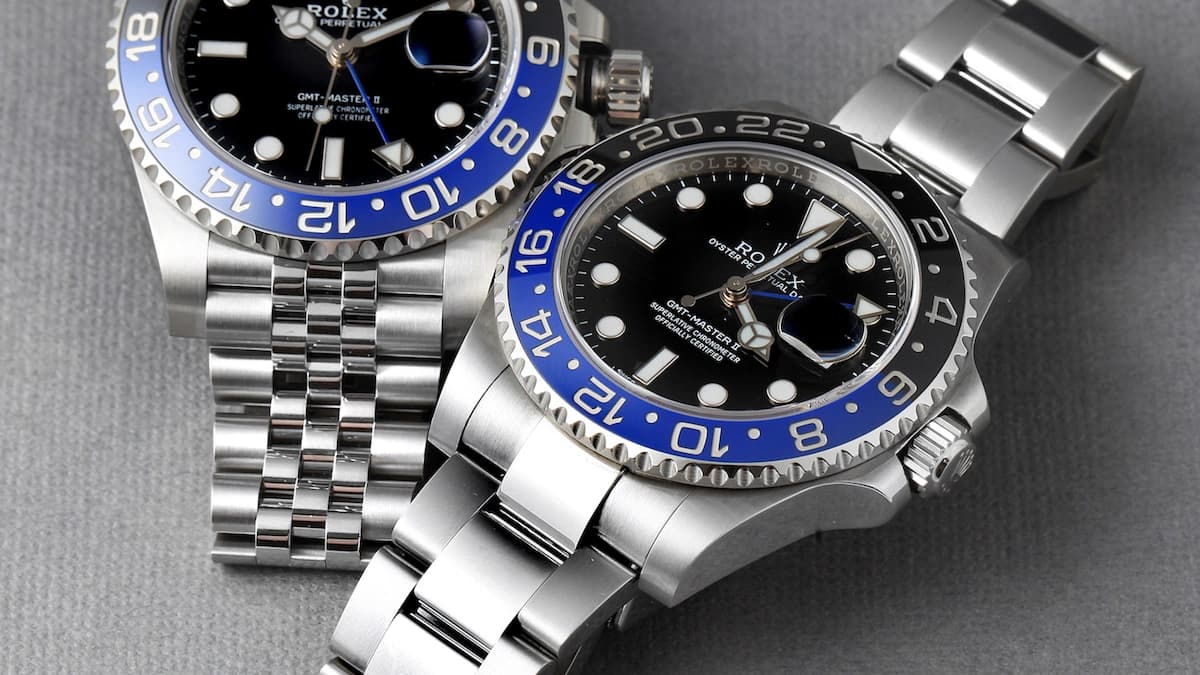
The Rolex Submariner 124060 specification describes scratch-resistant sapphire. It is useful to read that as a material property rather than a guarantee that no mark can ever occur.
Scratch resistance and impact resistance differ
A scratch concerns surface damage; a chip or crack concerns how the component responds to force. A scratch-resistant material can still be damaged by a sufficiently severe or unfavourably concentrated impact. Hardness does not replace information about the crystal's geometry and support within the case.
This does not mean sapphire always breaks easily. A material name alone cannot predict the outcome of every collision. Contact angle, force, existing condition and construction all contribute.
Do not test a crystal by deliberately scraping, striking or dropping it. Such actions can introduce damage without providing a reliable material identification for an owner.
The mark may be in the anti-reflective coating
Anti-reflective treatment, usually shortened to AR, reduces reflected light to improve the view of the dial. It is a separate consideration from the sapphire underneath. TAG Heuer notes that an external coating may be scratched while the crystal itself remains unmarked.
Coating placement varies. Omega specifies treatment on the inside for the Speedmaster Moonwatch 310.30.42.50.01.002, while the Ultra Deep 215.92.46.21.01.001 has treatment on both sides. One configuration should not be extended across the entire brand.
If a reference has internal treatment only, it makes no sense to automatically attribute an outside mark to an external AR coating. If it does have an external coating, a photograph alone still cannot establish that a line reaches the sapphire beneath. Check the reference and the actual piece.
What should you do when you see a mark?
Start with the viewing conditions. Deposits, wiping traces and reflections can change the apparent surface. We suggest cleaning according to the model's care instructions, using a clean soft cloth and avoiding forceful rubbing over particles.
Then inspect under diffuse and angled light, recording the position of any remaining mark. Photographs help explain it to a technician, but do not replace direct examination. Visibility at particular angles does not by itself establish depth or the affected layer.
For chips, cracks, a loose crystal or condensation underneath, avoid further water exposure and arrange an inspection. The crystal is part of the protective construction as well as the window onto the dial.
Do not choose an abrasive polish or remove a coating before establishing the configuration. A method intended for another material may alter the surface and its optical qualities. Discuss coating treatment, replacement parts and subsequent water-resistance testing with the service provider.
Ask about the exact crystal
Useful questions include:
- What supports the material specification for this version?
- Is AR treatment present, and on which side?
- Are there marks, chips or signs of a previous replacement?
- What parts and seal-testing options are available if work is needed?
For a replica, the authentic reference's sapphire specification does not establish the material actually fitted. Reflection colour or touch alone is not sufficient proof. Seek information and suitable inspection of the actual piece rather than a scratch demonstration.
Sapphire's strong scratch resistance is a valuable property. Understanding its limits helps you wear it with sensible expectations and avoid unnecessary intervention over a line seen under one particular light.
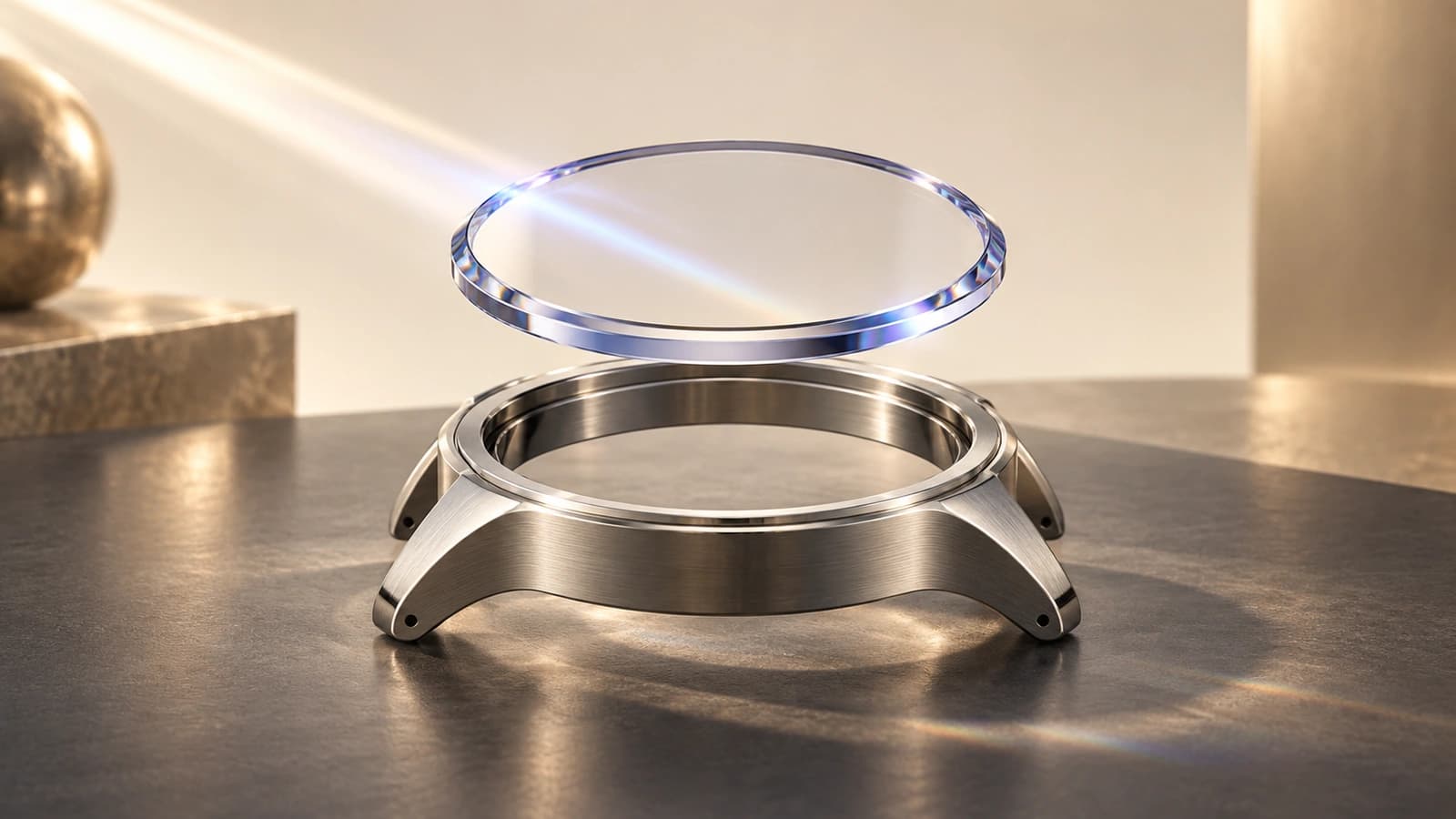
AI-generated editorial illustration of a sapphire crystal, not an actual product photograph.